
Summer 2008
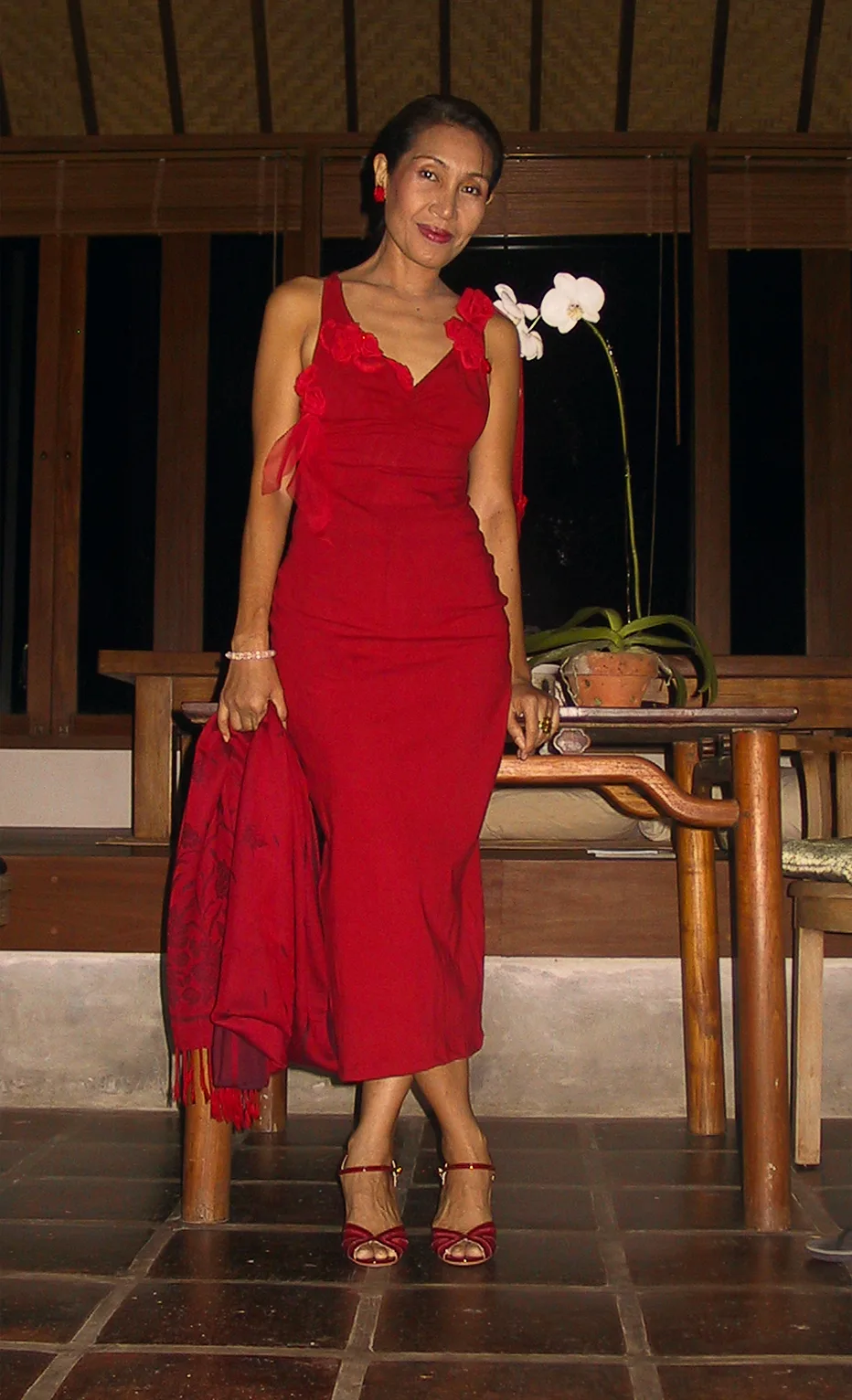
"Indonesia here I come..."In the late spring of 2008, I had the distinct honor and privilege of visiting South East Asia and lecturing in Jakarta, the capital city of Indonesia. The person responsible for my journey to Asia was a remarkable woman by the name of Jane Chen. This was my first visit to the region (with stays in Japan, Thailand, and Indonesia), and, to date, one of the most insightful and exhilarating experiences of my life. I had harbored dreams of making such a journey -my list of places to visit is long and at the time Egypt and the Arab Emirates had been on my sight. But this adventure came about not because of my own initiative, but as a response to an invitation from out of the blues.
An unexpected email
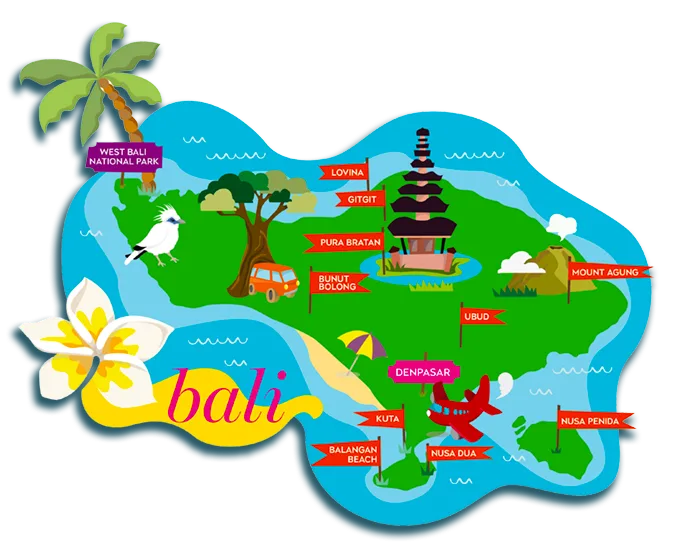
On a cold February morning, I received an email from the Indonesian island of Bali. As my life goes, this was not out of the ordinary. Since its creation in 2003, Muralmaster® has generated more than 100 pieces of correspondence from all over the world. At times it truly amazes me how the pages on my website are read and enjoyed by so many people who I never dreamed of reaching before the age of the internet. With over 100,000 hits on peak months, Muralmaster has done more for my career more than any other venue in the previous two decades. Doors have been opened -even doors ten thousand miles away!
I brewed a fresh cup of coffee, returned to my computer, re-read the e-mail a couple of times, and then a few more times for good measure. The letter was written with great care in a very beautiful and formal style of English that reminded me of the prose used by great English novelist such as Henry Rider Haggard or Joseph Conrad at the turn of the twentieth century. It was immediately obvious that the writer was one who had learned proper English later in life just as I had. This was all very interest and exciting to me because from an early age I practice a sort of meditation by analysing what clues I can discern about an individual from his or her writing. And as mysteries go, this one was a doozy -quite extraordinary.
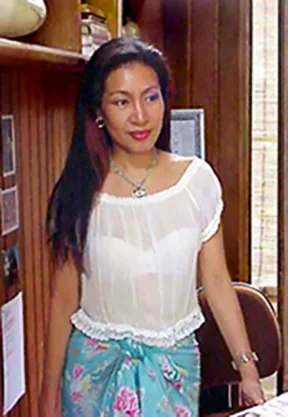
In this particular case, the person writing to me was Jane Chen, an Indonesian multilingual ceramist of Chinese descent, a world traveller who -to name just a few of the things she does, is also a performer, a White Crane martial arts practitioner and teacher, an aroma-therapist, and a business entrepreneur. This I got to learn much later (a little bit at a time) fore in this first letter, Jane did not say much about her at all. What she enthusiastically disclosed was how much she enjoyed my art and my writings, and then invited me to come to Bali and offered to sponsor the trip.
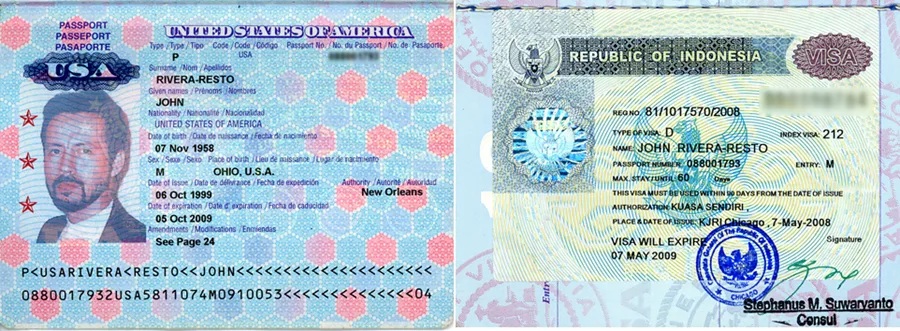
Again, for me this was not out of the ordinary. I have received invitations to visit other places and have been sponsored to do commissions, workshops and lectures in other countries. A few weeks before the letter from Jane, I had received a similar invitation from a friend to visit France. But I had been to France before -and loved it! However, Indonesia was on the other side of the world, it was on my list of places to go and here was my chance to do so. The adventurer in me was screaming to come out again and I desperately needed a change of pace to recapture the excitement of my youth. What better place to do so than the Far East?
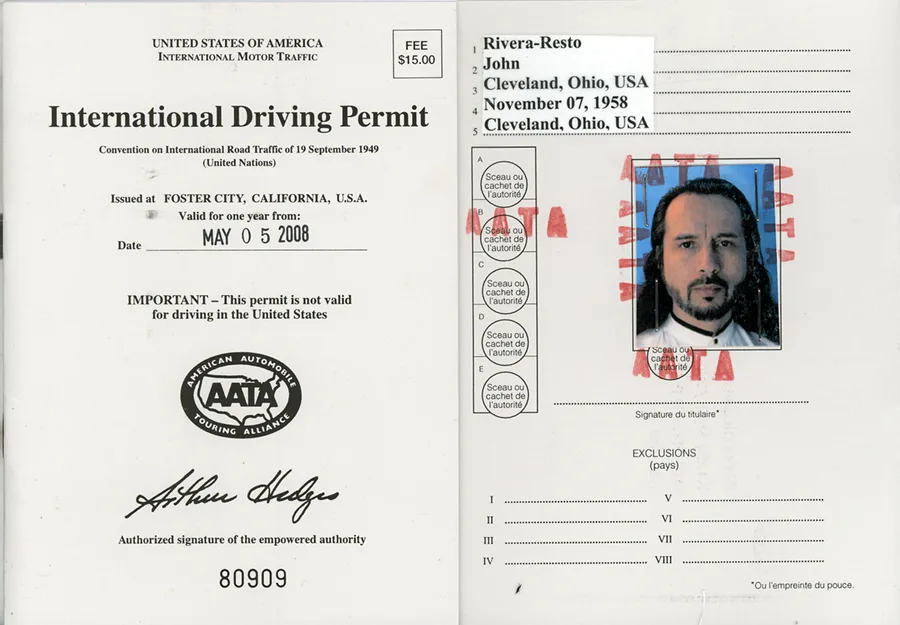
An animated exchange of letters followed, and eventually Jane and I had several phone conversations. Jane's English was excellent, sort of British with Americanisms thrown in at times (she had made long visits to the United States). By mutual agreement, I scheduled my trip for the middle of May. You see, Jane had done this before with other artists for cultural exchange programs under the banner of OnStage Bali. I would do a seminar consisting of a series of lectures and consult on some of her projects. And so, armed with an Indonesian Cultural Visa, my old laptop, an LCD projector and a couple of pieces of luggage, I set out for a three-week Asian adventure... that lasted three months!
Cleveland - Tokyo - Denpasar
For those of you who like to have their traveling and geographical facts in order, the distance between my home in Cleveland USA to the island of Bali in Indonesia is about ten-thousand miles. That's 24 hours of flights that included a couple of days layover in Tokyo, Japan, a place I always wanted to visit (I am a fan of sumo wrestling). The details of my journey and further adventures could fill a book or two. But since the scope of my story is to tell you about a mural I created during my stay in Jakarta, I'll leave the wonderful and magical travel tales from Japan, Indonesia and Thailand for another day.
The one thing I will mention now and later is how well I was treated by the wonderful people of these countries. I was also very fortunate to share my days with travelers and "ex-pats" from Viet-Nam, Malaysia, Hong Kong, Sumatra, Singapore, Australia, Argentina, Madagascar, Switzerland, Germany, Italy, India, England, the Arab Emirates, and even a few wild-flowers from the USA. But my heart remains with my new-found Indonesian friends in Bali, Jakarta and Batam.
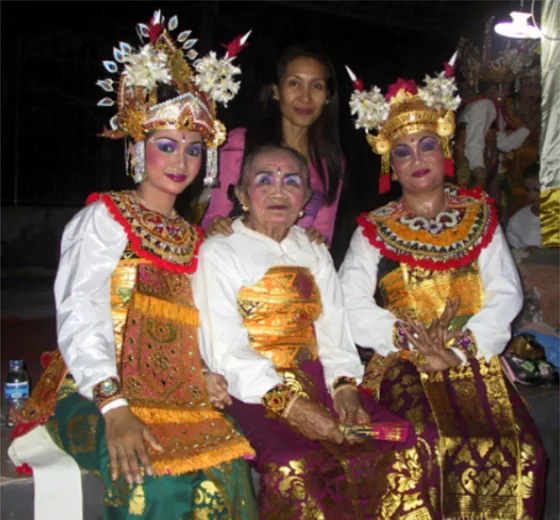
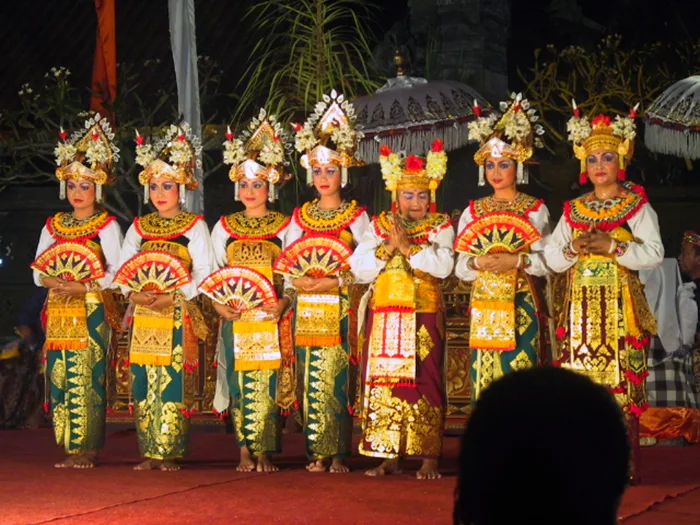
Jane welcomed me to Bali and I was immediately involved in her world: one inhabited by this multi-talented woman of layered complexities moving along several cultural heritages. She was a business woman, an entrepreneur, an eastern philosophy practitioner; a multilingual designer, artist, dancer, socialite, a Balinese-Indonesian-Chinese with Western affinities in a mind that wanted to absorb and experience it all. Jane was as imperious as she was generous, kind and witty. At times I felt I was either dealing with the Dalai Lama or a female Bruce Lee. But I love it all; never a boring moment. And beautiful and exotic Bali made for the perfect setting.
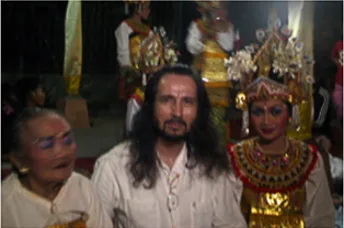
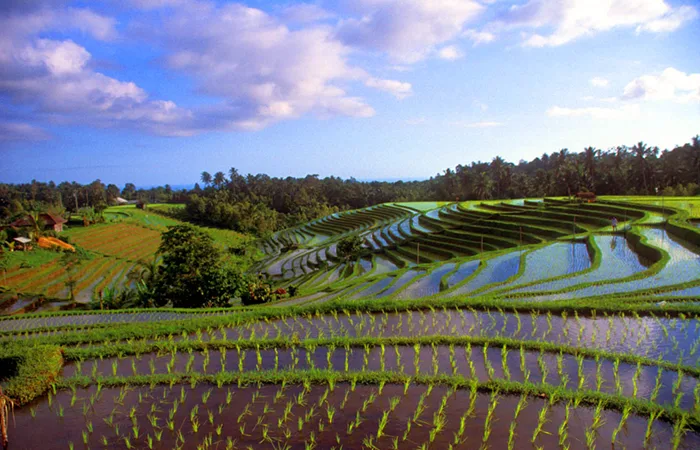
I soon discovered that Bali moved to its own beat. The people are rooted to the spirit of a land they have literally carved in unique patterns, and a simple way of life they express in so many wonderful and beautiful ways. What's more, nothing is done in a hurry and many adventurers from around the world have made Bali their home too. Few things are more exhilarating than enjoying wonderful and exotic meals by moonlight and torchlights in the company of some of the most interesting people in the world fluidly speaking to and fro in a babel of languages. Thankfully I could speak fluently in two languages, make myself understood in two more, while trying very hard to remember the few words I had memorized in Indonesian.
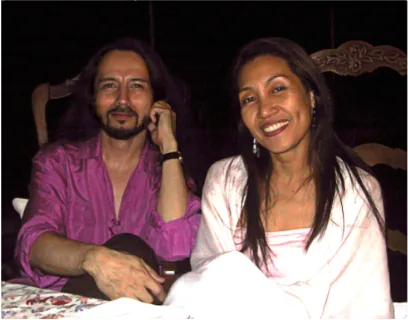
I grew up in a tropical island -Puerto Rico, were the weather is always summer and its stunning sunsets out of Van Gogh's palette. It is the place visitors and locals alike call "the island of enchantment" due of its natural beauty. But Bali has a magic of its own because of the diverse and sophisticated arts culture and the Balinese form of Hinduism that permeates every aspect of their lives. In no time at all I had fallen under its spell and had to pinch myself at times to make sure I wasn't dreaming. This was one of the defining moments in my life and I owed it all to my extraordinary host, tour guide and traveling companion Miss Jane Chen.
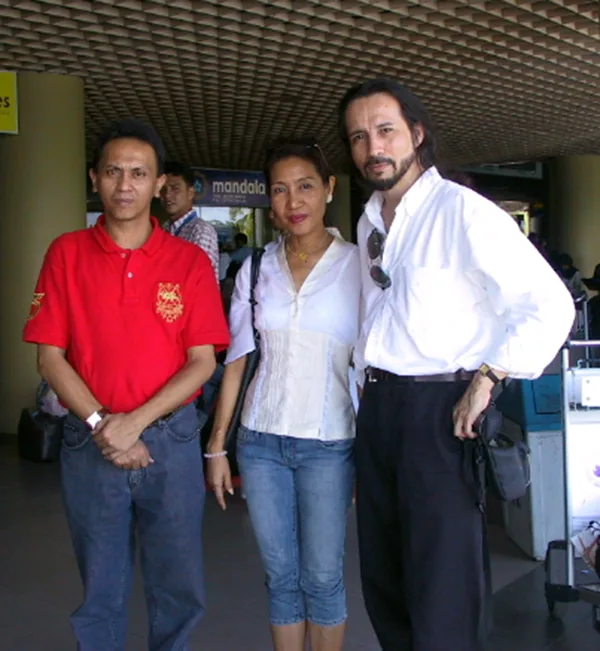
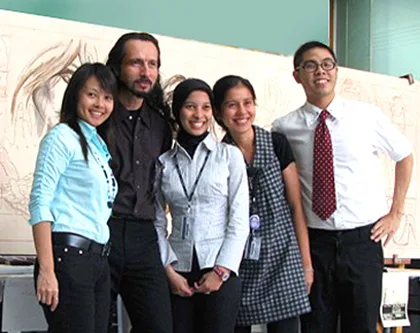
Jane had made arrangements for me to do a series of lectures in the Indonesian capital -Jakarta. I had the month of June to prepare and learn more about the culture. Jane had to travel to Batam to conduct a series of workshops for the Office of Culture and Turism and I accompanied her on the trip. Jane's audience was a room full of Indonesian Muslin women who, to my surprised, were thrill to have an artist from the land of "Ricky Martin and Jennifer Lopez!" This was my first encounter with a large group of Muslin ladies and I had a wonderful time. They were curious, animated, witty, and full of mischief. I never laughed so hard or posed for so many pictures because the ladies felt that "I had great energy".
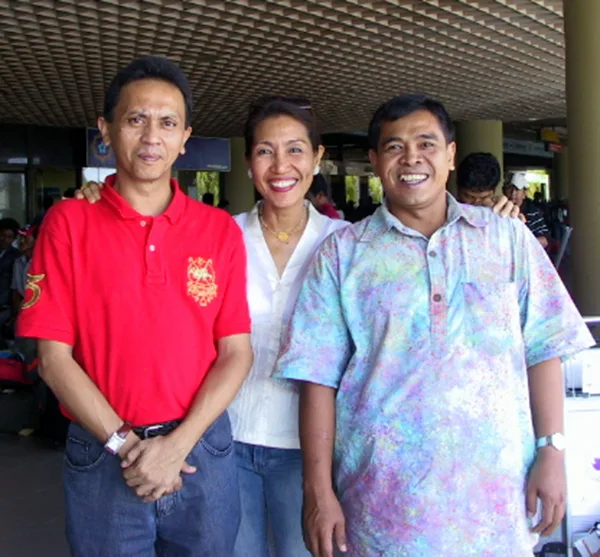
Back in Bali we traveled the island while Jane conducted business and enjoyed many of its cultural events, such as the annual Bali Arts Festival as well as other religious festivities that should be on everyones bucket list. But no visit to Bali is complete without traveling the beaches, mountains, temples, communal halls, the Monkey Forest Sanctuary, the restaurants and nightlife in Denpasar, and -last but not least, going for a swim in the water of the most beautiful water temple in Bali: the Tirta Gangga. In no time at all, June turn into July and it was time to head for Jakarta. And as soon as your plane lands in Jakarta's Soekarno-Hatta International Airport you realize that the contrast between Bali and Jakarta couldn't have been greater.
Jakarta
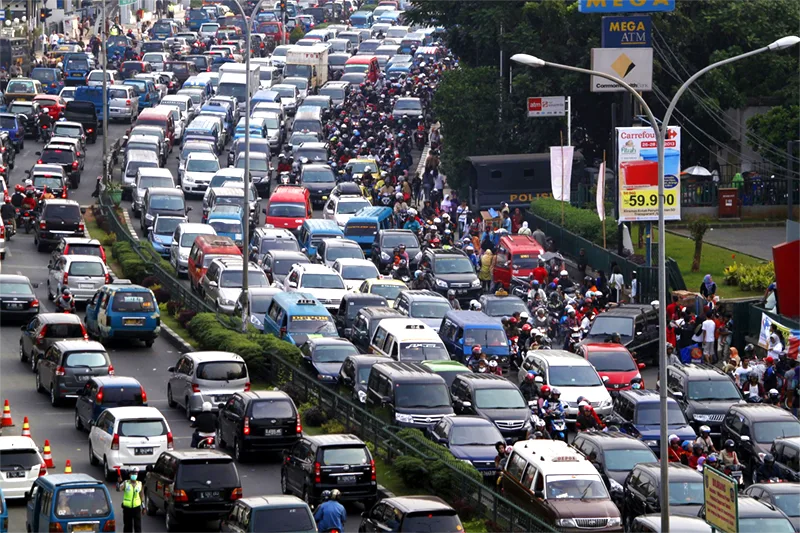
Jakarta is the capital and the largest city of the Republic of Indonesia, a Southeast Asian nation made up of thousands of volcanic islands and home to hundreds of ethnic groups speaking many different languages. The city is located on the island of Java and, with a population of over thirty million people, it is the second most populous urban area in the world -Tokyo being the largest. Traveling the city can be dizzying but never boring, a mixture of the modern and the old, the sumptuously rich and the underprivileged poor, in a dichotomy of languages, cultures, races and beliefs. With so many different languages and ethnic groups, it is difficult to describe or define a common culture for Jakarta -especially for any first-time visitor like me. But this is what makes the place fascinating.
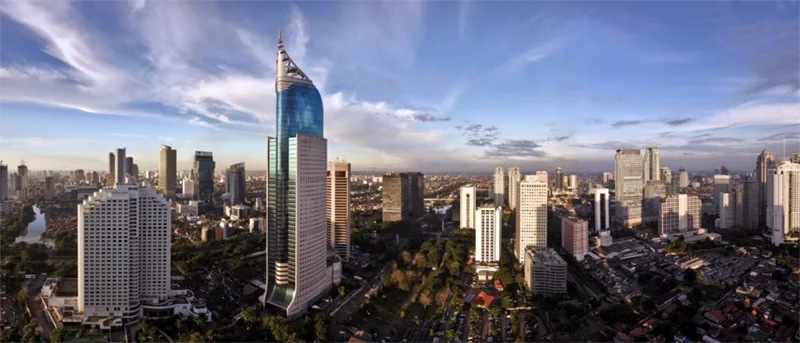
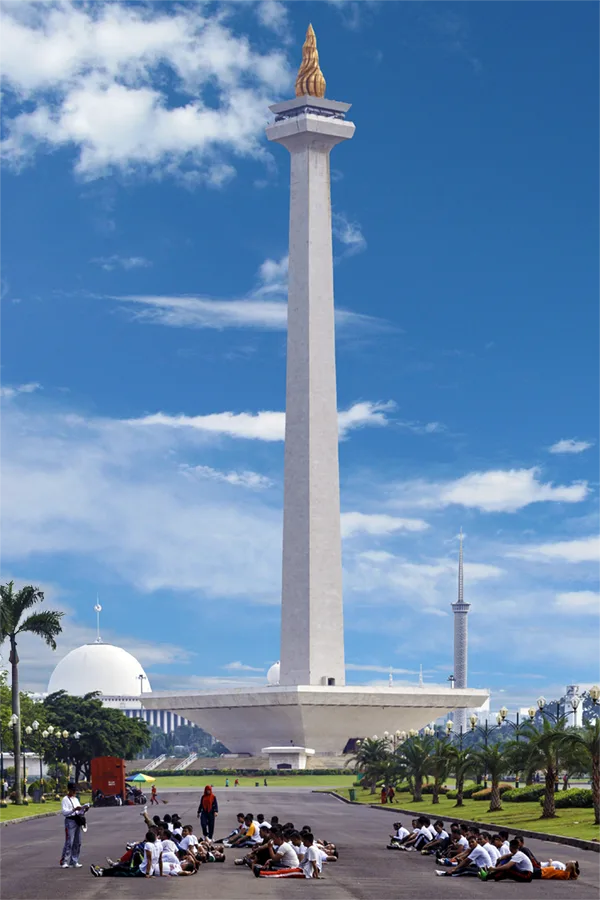
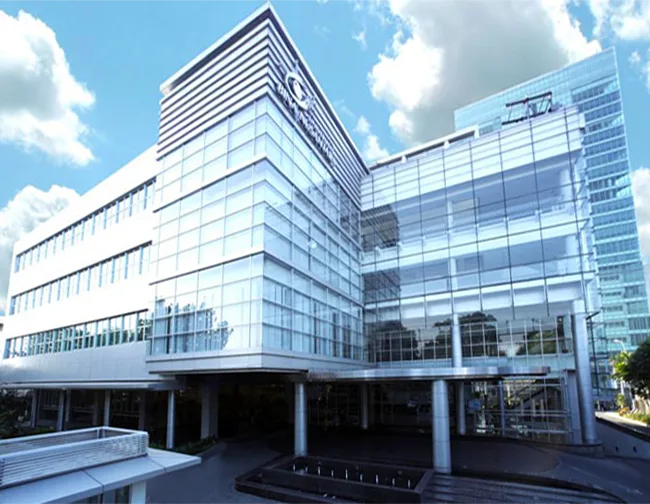
It was in this giant metropolis where Jane had made arrangements for me to conduct my seminar and mural painting workshop. The event was initially thought to take place at the National Museum, but the location later changed to the modern facilities available at BINUS University some six miles (9.5 km) from the museum. Bina Nusantara University, also known as BINUS University, is a private university in the heart of Jakarta. With concentrations in business, management, communications, design, engineering and high tech, BINUS offered an ideal setting to host the event.
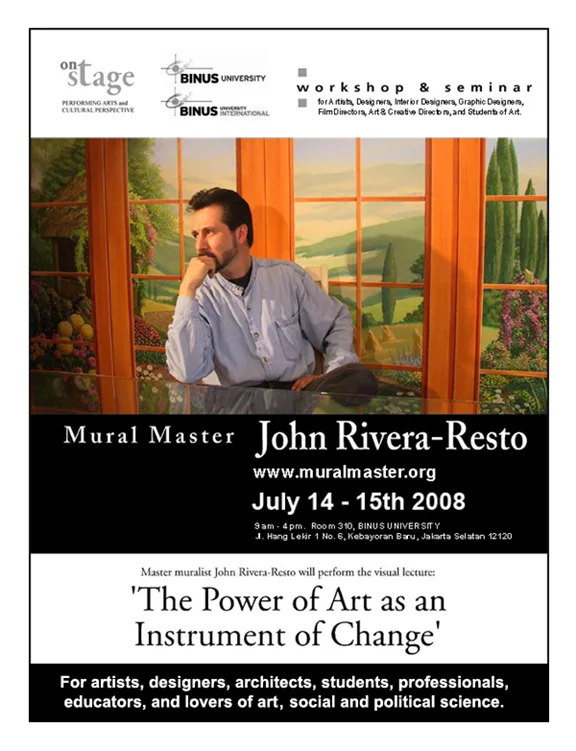
The Power of Art as an Instrument of Change
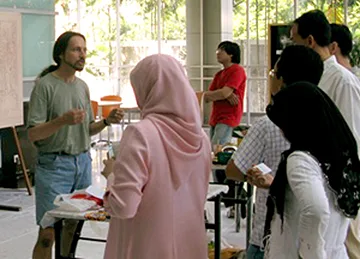
The title of my seminar was: The Power of Art as and Instrument of Change. It consisted of a two-day presentation of interrelated visual lectures on the subjects of art theory, art philosophy, propaganda art, and the use of art as a tool to attract business and capital to the city. But I also infused the lectures with anecdotes and insights on the amusing similarities and differences between our two cultures and how art becomes a common bond that brings us closer.
The lectures were in English for an audience of college students and professionals who had good understanding of the language. However, my lecturing narrative style is so visual (using hundreds of images, diagrams and illustrations arranged in Microsoft PowerPoint) that even people with limited command of the language were able to follow the thread. Also, my delivery is closer to a live performance in which I also use sound and music to further audience immersion and enjoyment of the subject. Feedback from an audience is immediate because I can easily gauge their reaction and make adjustments as I go. When they laugh in all the right places, I know I'm good to go.
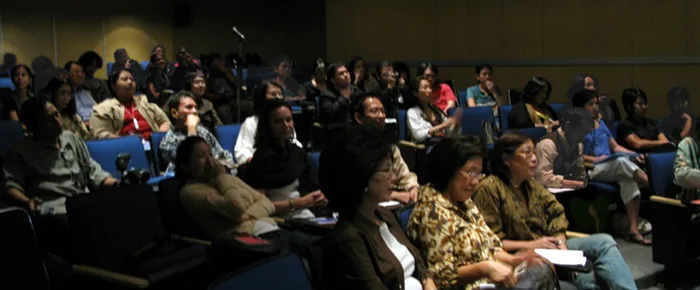
I was delighted with the cognition quality and professional range of the participants. When a presenter and the audience can communicate in the same intellectual wavelength, the engagement in critical thinking produces greater understanding and exchange of ideas. It is so easy to feel right at home in this kind of setting. I love teaching and learning and was immensely rewarded with the fact that everyone I met at the seminar also shared this passion. I believe they were as curious and eager to listen to what I had to say as I was curious and eager to hear and learn from them. We had a wonderful time.
The Painting Workshop
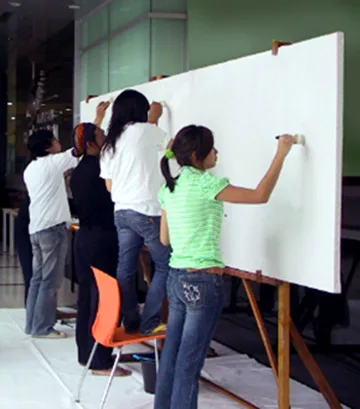
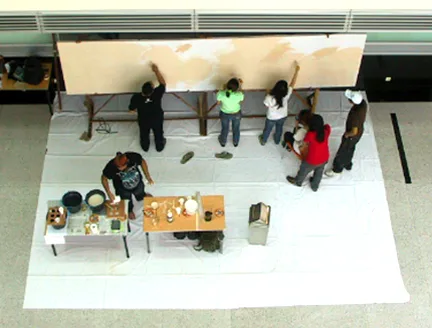
After the two-day seminar at BINUS, I began the painting workshop. A large canvas stretched over wooden panels was set up on the main atrium. Volunteers had worked during the seminar and had it ready for me to begin immediately after. The piece was constructed to design scale. The purpose of the painting workshop was to demonstrate my mural painting method and techniques. However, creating a design for the painting took some consideration. First I needed to come up with on the subject matter and then I had to create a design rendering (a line drawing) for the painting. But by the time I flew from Denpasar to Jakarta, I still had no ideas for the subject.
When you have a "mental block", it's best to rely on what you already know from prior experience. This is a good starting point. Early in my career, I had noticed that students become more engaged in painting workshops when they are familiar and impassioned with the topic represented in a work of art. Also considering that the participants and viewing audience were young college students (for the most part), I decided to use as my theme something that is an easily relatable universal yearning among all young people of the world: "romantic love."

It so happened that I was following a couple of evening soap operas in Jakarta in the company of the host family I was staying with when the realization hit me. All you have to do is watch television shows in any country to see romantic soap operas at the top of the viewing list. They were as addictive as Spanish language soaps (telenovelas) and in no time I was explaining the plot lines the Jane Chen to her astonishment. By the way, this is an ideal way to learn a language. Anyway, that's when I concieved the idea of using as the theme of the painting one of the greatest soap operas of all time -one that was familiar to the people of Indonesia: the Ramayana!
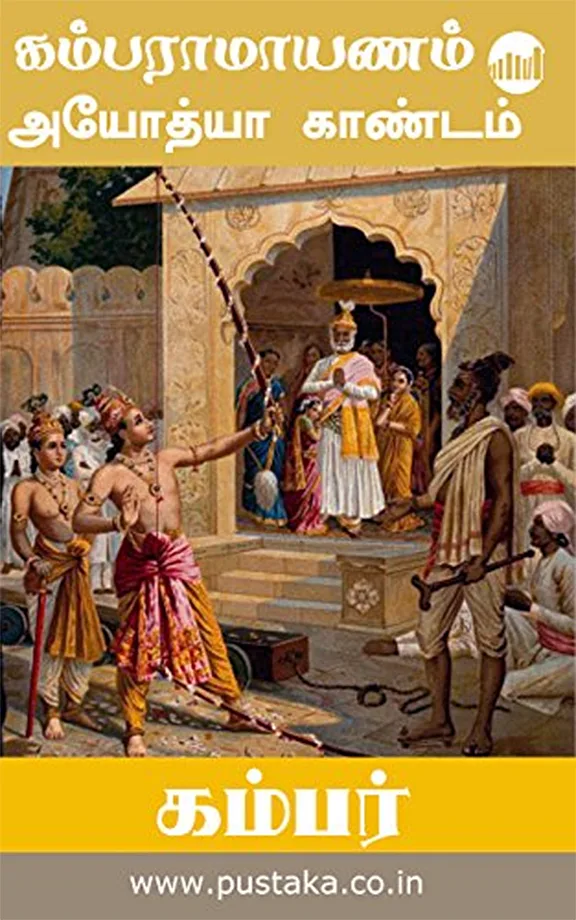
The Ramayana is an ancient Sanskrit epic poem of love and courage. Sanskrit is the ancient Indic language of India, in which the Hindu scriptures and classical Indian epic poems were written and from which many northern Indian languages are derived. The Ramayana follows Prince Rama's quest to rescue his beloved wife Sita from the clutches Ravana, demon-king of Lanka. The epic is one of the most literary works of ancient India, it has greatly influenced art and culture in the Indian subcontinent and South East Asia.
There are many versions of the Ramayana -including several versions in Indonesia, such as the Javanese Kakawin Ramayana (sometimes called the Balinese Ramayana because it is where is now culturally preserved) and the Ramavataram. This Sri Lankan version of the Ramayana, also known as the "Indonesian Ramayana" because of its strong cultural influence in this region, was written in the Tamil language (which is spoken mainly in southern India and Sri Lanka) by the poet Rishi Kamba in the twelfth century. However, regardless of the version, the core story and characters of the Ramayana remain the same.
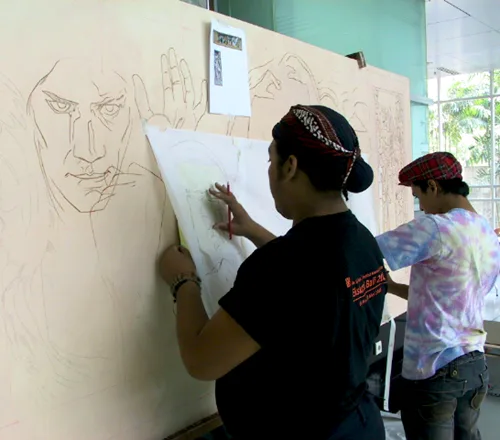
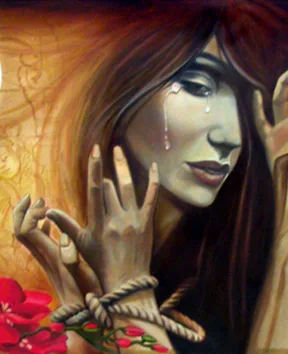
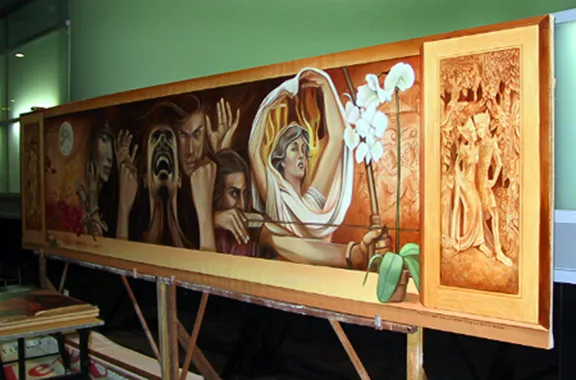
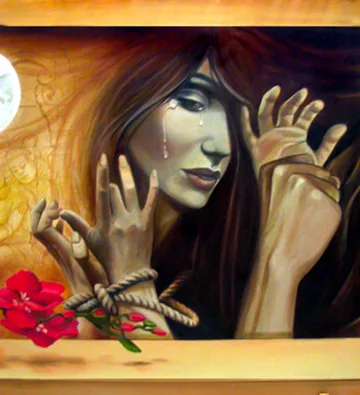
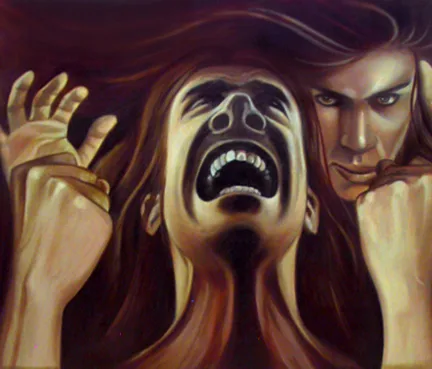
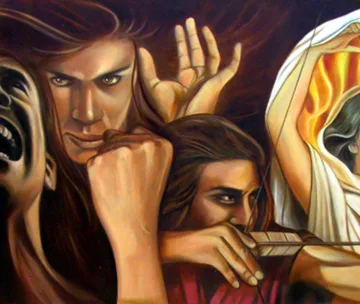
Now that I had a theme, I proceeded to create a design condensing the Ramayana into a narrative told in five sequential portraits of Sita, Rama, and Ravana. I framed these portraits with features from Javanese and Balinese art that represented elements of the story in carved wood and stone. Lastly, I included moon orchids with the colors of the Indonesian flag. The composition centered on Rama's anguished expression when he discovered that Ravana had kidnapped his beloved wife.
One advantage of doing a story that everyone knows is that you do not have to explain much. All you do is present some key elements and the public's memory fill the rest of the gaps. This was my approach in this type of design oversimplification. But technically, this was still a very challenging composition, especially when you take into consideration that it had to be completed in the space of four days.
But the point of this workshop was not to make things simple and easy, but realistic. This is what muralists do. We are hired by clients to create large-scale works with a purpose other than to decorate. Because of their public nature, murals can educate, persuade, promote or diminished ideas and practices, and even generate a desire mood on the viewing public. And as a result murals can affect public opinion. This is powerful! How this was done had been discussed in the seminar. Now the practical part was to make it happen by creating an ambitious work of art in a very short time.
From the beginning I made clear the fact that -"I'm a businessman that paints". In other words -"I paint for money; this is how I make a living." You have to paint fast and be able to produce quality work in a short amount of time. Murals are priced ahead of time, and once you agree on the cost, you can not afford to take longer than the estimated time or go over budget or else you will loose money. So the faster you deliver, the more money you will make. This is why you have to be really, really good in this business. In this workshop, I was going to teach how I do it so other artists could do the same.
Creating A Design
Now that I knew what I wanted to do, I have to produce a visual design. I did very little research for this painting, relying mostly on past recollections of the story. I had read an abridged Spanish version of the epic while in high school in Puerto Rico. In subsequent years I had also brushed up on Indian mythology so I knew fairly well the basic plot of the epic. This limited knowledge would not get me passed any expert tests but I felt it was enough for what I had in mind: and extreme summary of key elements of the story.
I wrote down a chronology of events and then proceeded to eliminate all but the absolutely necessary to maintain a beginning, a middle and a conclusion. What remained was as follows: 1- Sita is kidnapped by Ravana, 2- Rama's reaction to the kidnapping, 3-Rama's killing of Ravana, 4- Rama's suspicions of Sita's infidelity, and lastly, 5- Sita's trial by fire to prove her purity.
But I soon realized that even in this bare-bones framework of the story, the narrative composition would be too big for a painting of this limited scope and time-frame. I could have picked only one of the five listed episodes as the theme for the painting, but my style of mural painting is one of panoramic narrative, one that tells an entire story.
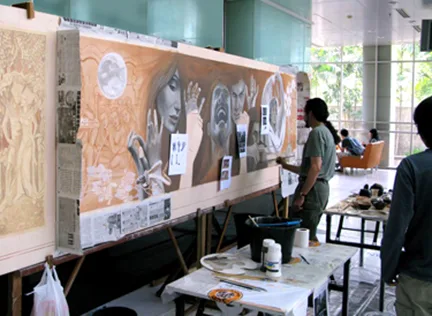
Like I mentioned before, as I pondered the problem it occurred to me that when everyone is familiar with a story, all you have to do is to trigger that memory. So by providing only "visual cues", I could make the viewer see the entire episode happening in his or her mind. In the end, this is exactly what I did. Finally, with my composition for the painting completed, I made a few copies of the rendering and figured out the dimensions for blowing up the design to a larger scale.
Transferring The Design To The Painting Surface
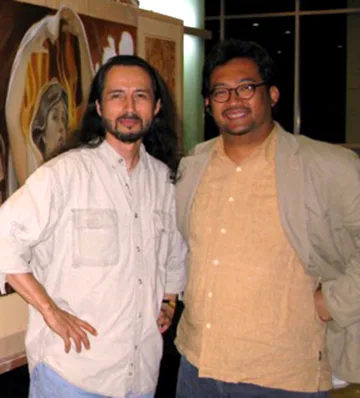
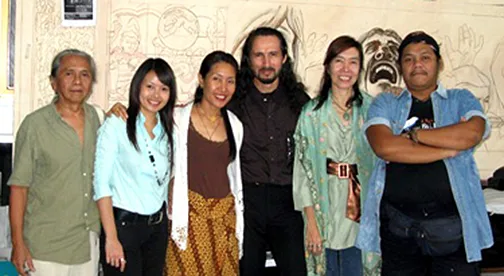
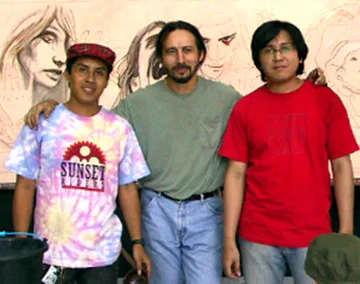
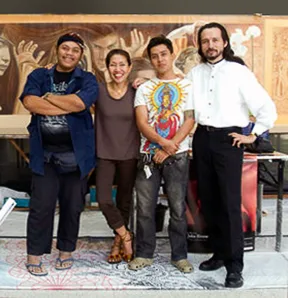
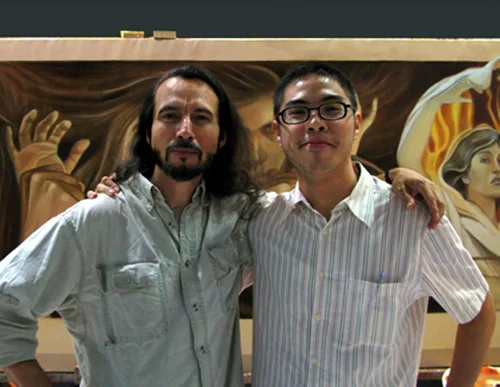
Jane had done her behind the scene magic doing all the necessary arrangements with BINUS University, providing a buffet lunch for everyone during the two day seminar, and recruiting volunteer artists and students to participate in the painting workshop. Two of these artists were Aditya L. Tubing and Guntur Wibowo. They each had their unique set of painting skills and individual styles that you would not normally see in a collaborative work. But for this workshop they would be learning how to work using the methods and techniques I have tested and developed as a "commercial" muralist.
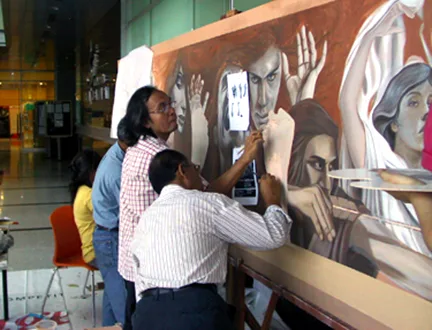
I have many ways to approach a painting. Painting surface, size, the subject, and above all -the budget and time-frame for completion, will determine the method I will use. On large projects I chose who will be working with me based on the skills demanded by the job. So the beginning of my selection process looks a lot like Mr. Phelps selecting his 'Impossible Missions Force' team in the popular TV series Mission Impossible.
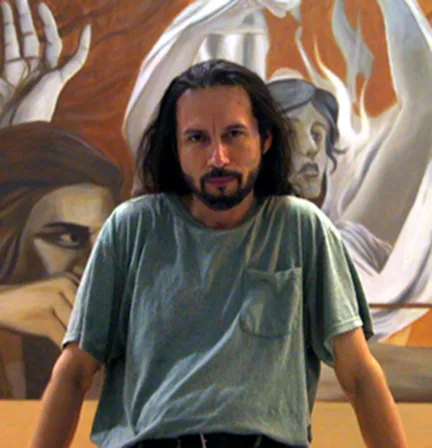
Painting began the same day of the seminar as Aditya and his volunteers prepared the canvas panel making it ready for the beginning of the workshop. As soon as I completed the seminar, I gathered the group, showed them the design and explained how we were going to proceed. It is my working habit to make sure everyone working on a project knows everything we are going to do right at the beginning. By doing so we can anticipate any unforeseeable problems early on and also make the project run smoother and faster. No matter how simple or complex a project may be, everyone has an interdependent role to play and everyone knows how to go about it.
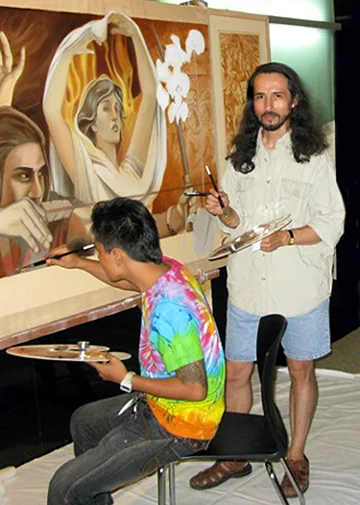
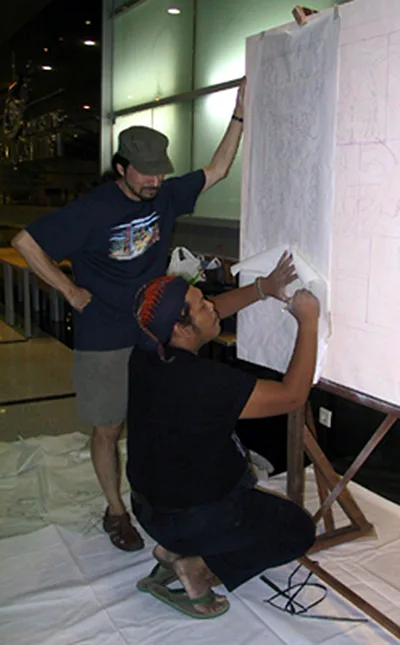
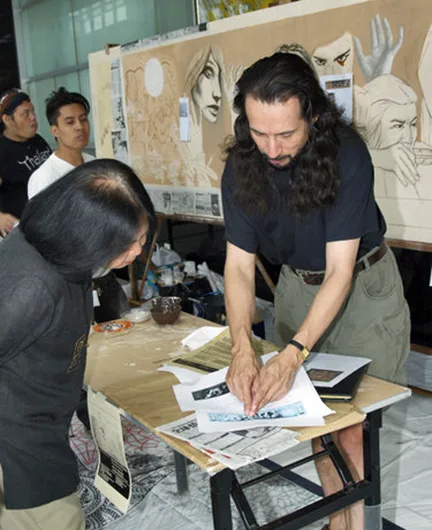
Our first task was to transfer the design to the painting surface. This was done by combining the grid method with projection. The grid consists of dividing the painting surface into one-foot squares. Then each square is identified by them given them horizontal and vertical coordinates, which could be letters or numbers. The design is also gridded to scale, so that the horizontal and vertical squares on the design match the ones on the painting surface. Lastly, a large sheet of paper the same size of the painting surface is also grid to match it.
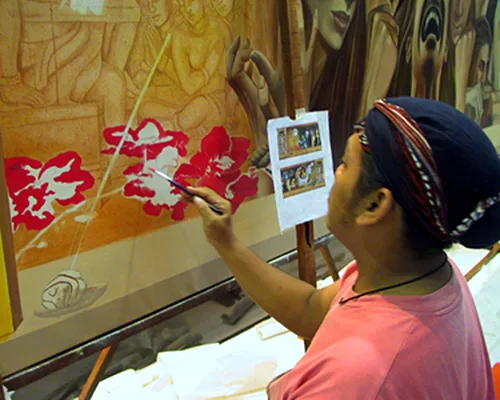
Next, the design drawing is divided into sections and each section is projected unto the blank sheet of paper that was already gridded. The projection is carefully adjusted so that the grid lines on the design match the grid lines on the paper. Once everything matches, the drawing is traced to the paper. In the end, after all the sections have been traced, you will end up with an exact-to-scale drawing of the design.
Now you copy the design to the painting surface. This is done by placing the paper drawing into position and tracing the drawing. But first you have to rub the back of the paper with either charcoal or color chalk so that your tracing leaves a visible mark on the painting surface. You can either do the entire drawing at once or you can cut the paper into sections and do the tracing a section at a time -which is exactly the way we did it. The end result is that you have the design perfectly drawn on the painting surface.
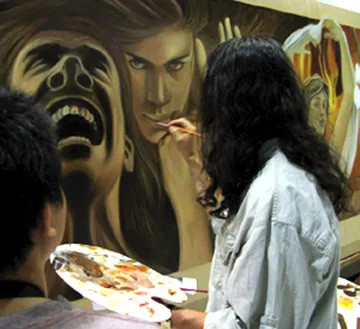
This seems like a lot of work. Why not just draw the design "free hand", without the use of any mechanical aids? Keep in mind that while sometimes, depending on the kind of job, this may be a perfectly acceptable way to do things, in mural painting you need to reproduce the art exactly as it looks on the design that got you the job in the first place. Also, when you are working on a large scale you don't have the reach or the distance to eye thing up accurately. What's more, when you work as a team, everyone can create a perfect drawing regardless of their skill range. This versatility maximizes your options to utilize talent.
An alternative to not using a projector is to do the grid on the design and the painting surface, and then draw the design free-hand by using the grid as reference points and matching the lines on each square as perfectly as possible. I have done it in every conceivable way. But it is always good to have a paper drawing on hand in case you have to redo a section. But the bottom line is that more people can work on a project -and achieve the same result, if you use the proper method.
Painting Step-by-Step
Now that we had a drawing in place we could begin the painting process. But first, we had to seal the drawing outline so that it would not be accidentally erased and to also make it clearly visible. This is done by "inking" the drawing. This means that you go over the drawing with either fluid paint (paint that has been diluted with water or solvent) or... ink. Some people use permanent markers but this is not advisable. Permanent markers use a dye that keeps showing through your painting. During the inking you also fill out any dark areas in the painting so in the end you get a good sense of what the final work will look like.
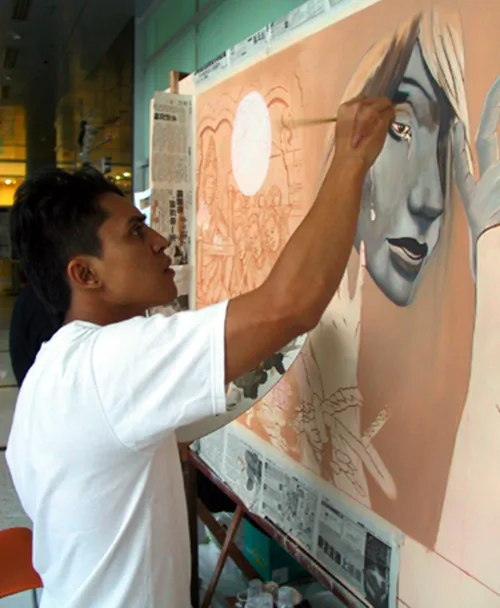
The next step was to paint the main figures in gray-scale (achromatic shades of gray) using only black and white oil paint. This is where you take your time to get thing right and your blending perfect. That's the advantage of working with oils: they take a long time to dry. Since you don't have to worry about color, your concentration is entirely focused on likeness, values and contrast (almost like watching a black and white movie). If you do this right, adding color will be as easy as applying makeup. If you are really good and fast at modelling, you can do this process using water-base acrylic paints. But for portraiture of this kind, using oils is best.
While Guntur and I worked on modelling the figures, Aditya worked on painting the end panels and flowers. I purposely kept a limited color palette on the background. The design was basically painted in brown monochrome and then color tinted. This was done to make the figures stand out more and because we didn't have time for embellishments. To speed the drying time of the gray tones, I added a drier to the painting medium. It would still dry slowly, but would be completely dry by the next day.
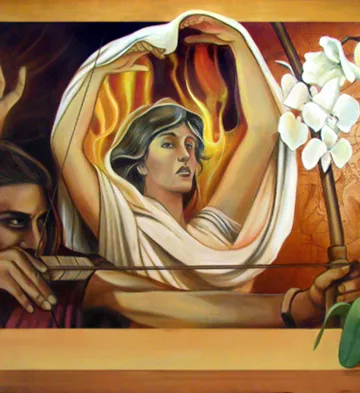
Now the fun part began: glazing colors. This is where you begin to add color tints to your painting. Applying a glaze on a grayscale image is like applying makeup to a face. You dilute color with your painting medium into a semi-transparent state and rapidly apply it to your painting. The beauty of the method is that you will never cover up the painting underneath. It will remain visible for you to make any adjustment to the color or deepen any shadows. Once you apply a glaze you let it dry and then you continue applying more color tints and shadows over it. The final result can be astonishingly realistic and three-dimensional.
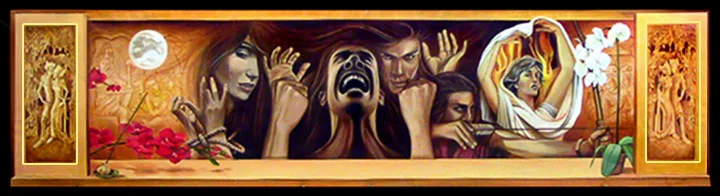
Sponsors: Jane Chen and BINUS University, painting workshop, Art as an Instrument of Change Seminar, Jakarta, Indonesia, 2008.
By adding more drier to my medium, I was able to apply at least two to three layers of glaze to the painting. Finally, I when through the entire painting applying highlights, tints and deeper shadows as needed. These are applied almost full strength without diluting the paint. And with that, the painting was done. I could have spent a month on this painting instead of four days adding a least a dozen glazes. But the results were convincing and I was able to show my painting technique for this type of art. Now all that was left to do was to let the canvas dry, apply a coating of varnish to seal in the thin glazes and bring out the color, and lastly, glue the canvas to a wall. In case you have not notice it, the design was made up to be positioned like a window on a wall. That's a mural!
Bangkok, Bali, and Back Home
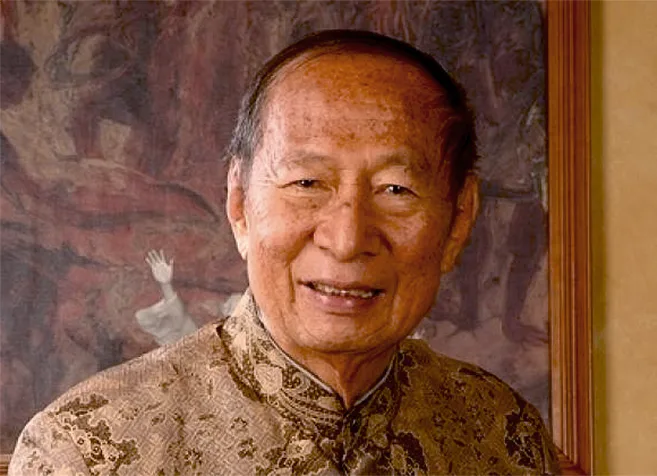
Once the mural was finished I had time to meet with a couple of journalist for a profile, make a few social calls and also attend a gallery show. But one of the most thrilling moments was meeting Mr. Ir Chiputra, a.k.a. Tjipoetra or Tjie Tjien Hoan, the legendary Indonesian businessman and developer, and also the largest philanthropist in the country. He was in the middle of planning a museum to house his extensive art collection and wanted to consult on the execution of a large mural design by one of Indonesia's most prominent artists. At 79 he was still as sharp and upbeat about new projects and ideas as a man half his age. I was honored by just meeting him, and much more for being asked my opinion on his project.
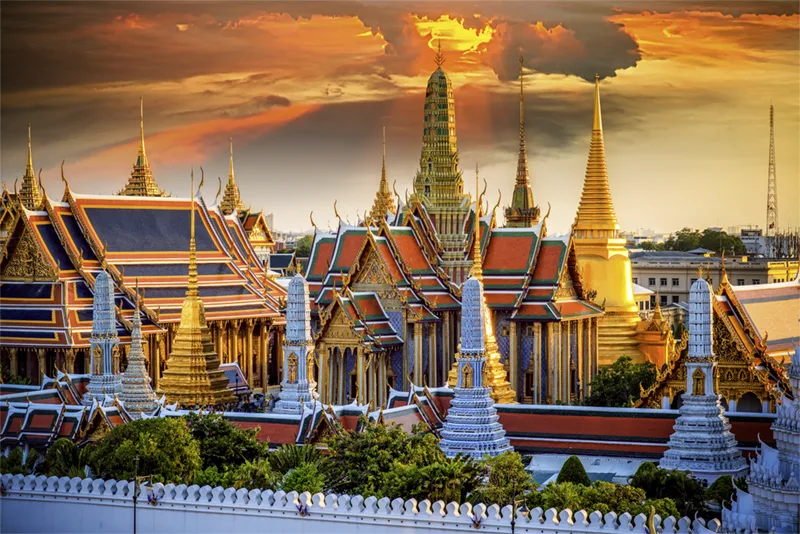
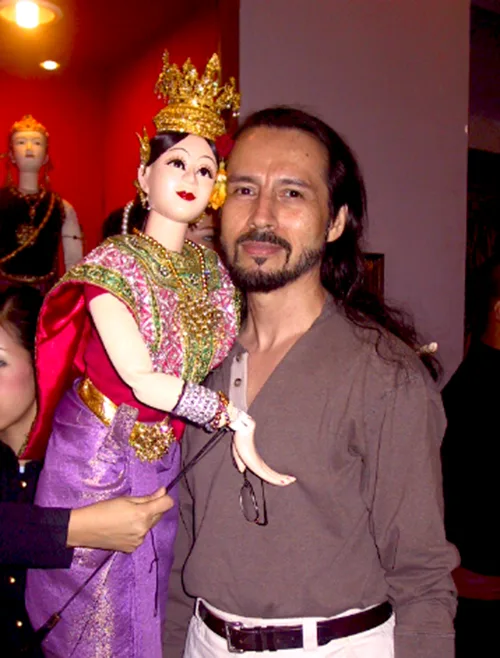
Later on, after a few days rest in Jakarta, I accompanied Jane on a business trip to Bangkok, the capital of the Kingdom of Thailand. There are two things that immediately come to mind when you think of Bangkok: ornate temples and shrines and a vibrant street life. The architecture is awe-inspiring and the glittering decoration like no other. Some of their shopping centers and department stores can fit several of our Cleveland shopping malls combined, and the sprawling Chatuchak Weekend Market and the Taling Chan Floating Market are a must see on any tourist list.
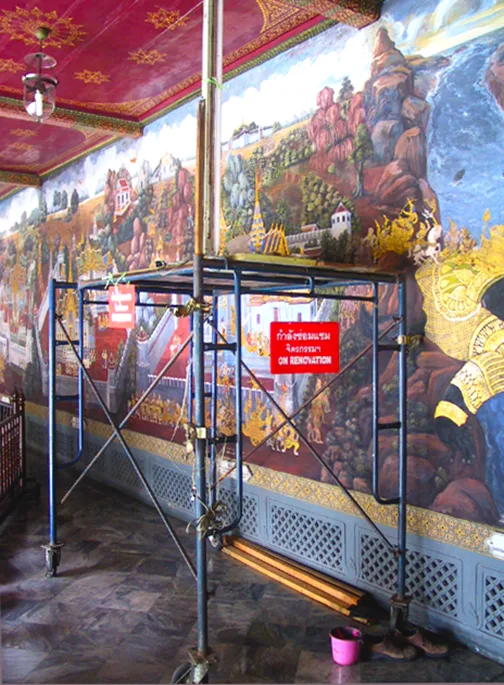
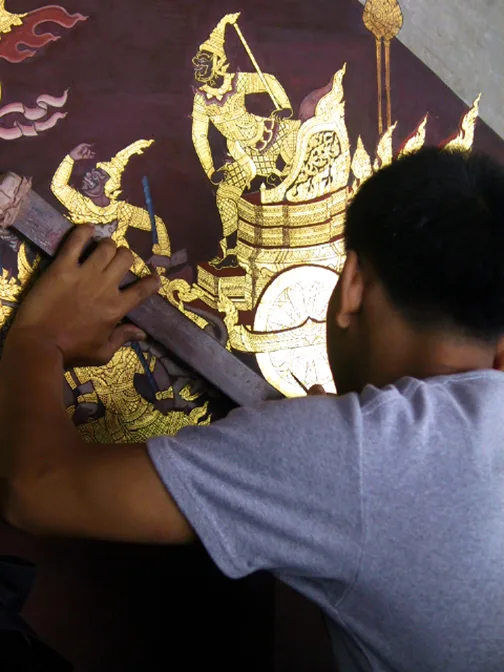
There is much to say about my experiences in Thailand, but the one that pertains to this narrative has to do with murals. The temples and palaces are covered and fantastic murals and it is a never-ending job to maintain and restore them. I spend a day talking to the artists and monks doing this taxing task and learning from them all I could about the art of restoration. The challenges are huge and with so many thousands of works in need of conservation there are not enough resources and technicians to keep up with the task.
Bangkok is one of the world's top tourist destination cities and Thailand's center of wealth and modernization. The few days I spent here were not enough to fully explore all the treasures and complexities this city had to offer but I did make new friends, experience new perspectives and broaden my knowledge of this part of the world. After this whirlwind visit to this most exotic of places, we returned to the calm and simple pleasures of Bali. My three-week trip had become the three-month journey of a lifetime.
All good things must come to pass and I had to say goodbye to Bali and all the happy souls that made me feel like their most honored guest. A part of me wanted to stay and see more but another part was getting homesick and yearning to return to my family and loved ones I left behind. There was also a girl that was missing me terribly and I had grown rather fund of her. And so, after another layover in Tokyo, I return to home to Cleveland with a fresh smile and a happy heart.