
The Thinkers Coffee Shop Mural
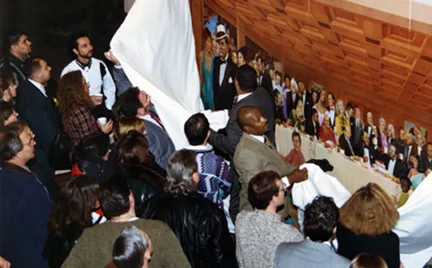
The Thinkers Coffee House Mural is one of the significant and defining highlights in John's career as a muralist. John began working on the project in 1994 and the finished masterpiece was unveiled in 1995, in the City of Cleveland, Ohio USA. The art work consisted of a star-studded extravaganza painted within the highest standards of academic painting. It was commissioned by Mr. Charles "Chuck" Diamond as the centerpiece of his dream coffee house in Cleveland's celebrated Playhouse Square District. In every way John's work of outstanding artistry surpassed even Chuck's most exalted aspirations. With this mural John cemented his reputation as a master of his craft.
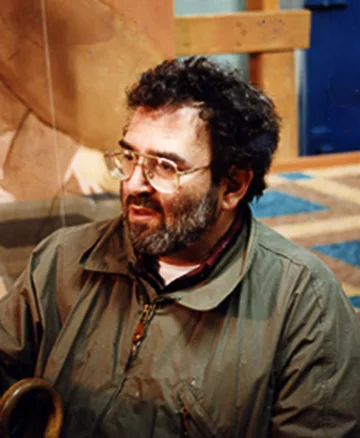
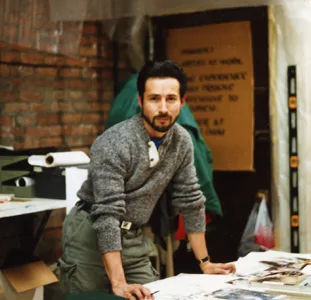
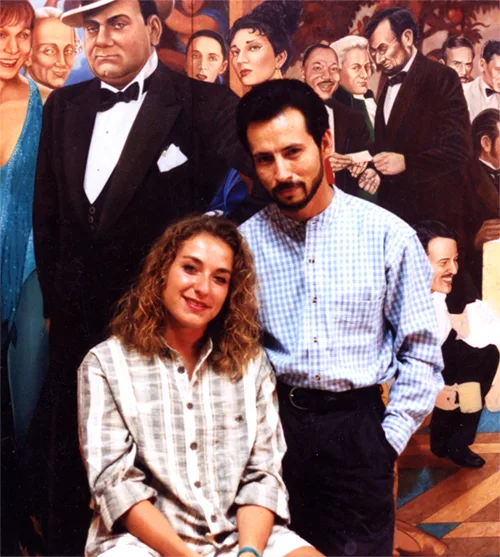
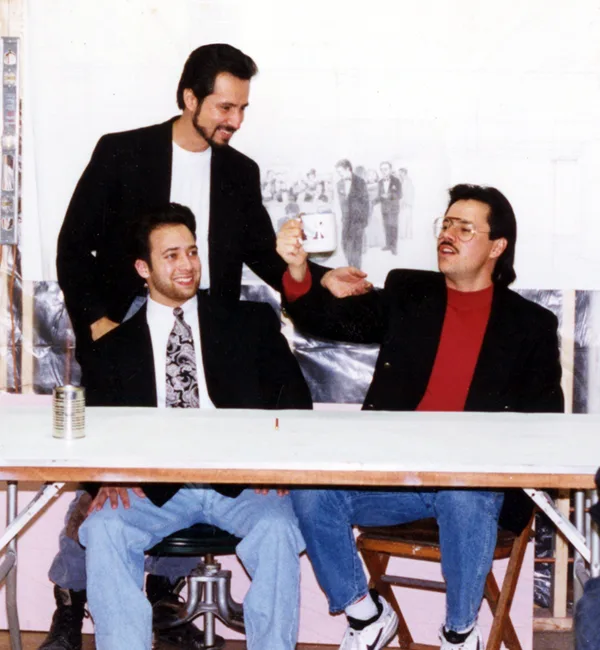
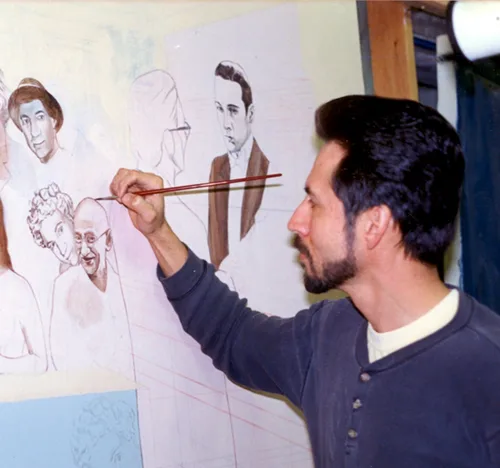
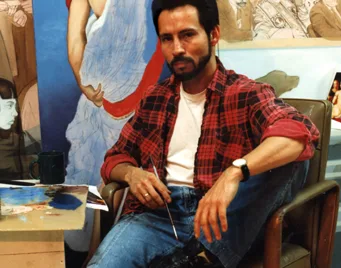
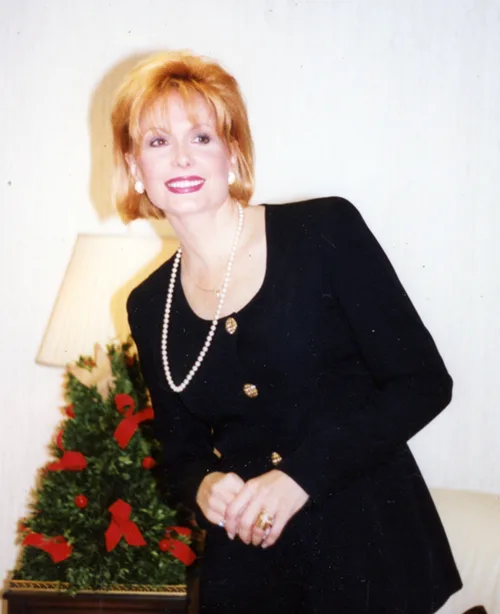
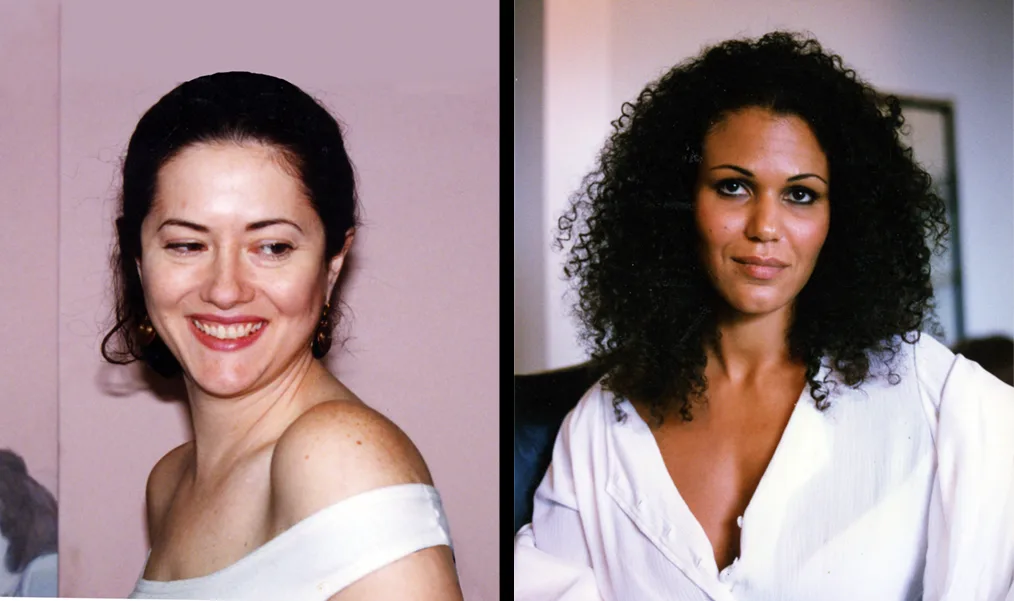
The mural was painted on a series of canvas-covered panels in John's studio and took one year to complete. Miss Karyl Kniepper, John's friend and collaboration in several interior design commissions, also worked on the mural under John's guidance and supervision (notice John's portrait of Karyl in 'the Paintings' section of this website). John and Karyl shared an integral quality essential for this kind of work: a taste for coffee and the capacity to work punishing late night hours seven days a week.
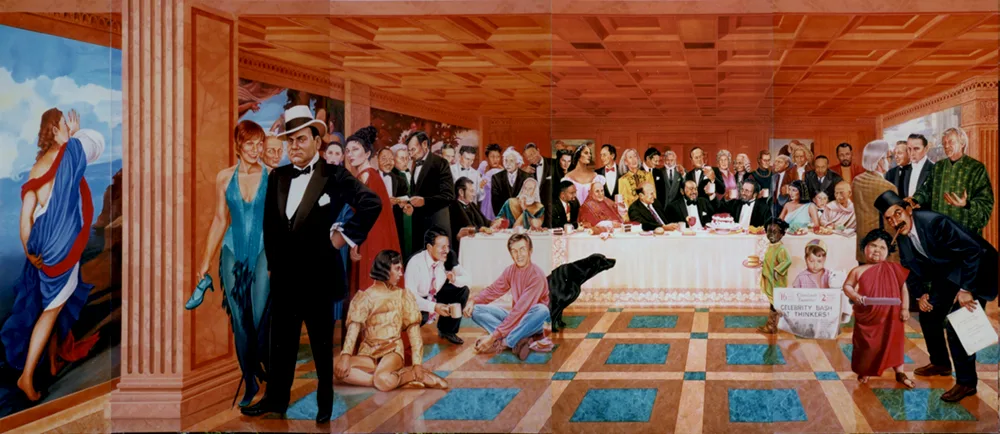
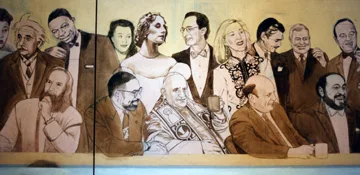
The mural's composition is based on Leonardo da Vinci's 'the last supper' mural, with a gathering of "guests" at the main table inside a small salon decorated in wood-coffer ceilings, walls covered in murals by Titian and other renaissance masters, and gorgeous patterned floors of polished marble. The long table served a buffet of fruits and delicacies over a tablecloth of a beautiful Italian design. The attention to detail is remarkable.
Two months of extensive research and preparation went into achieving the mural's final design. A list with hundreds of individuals was prepared by Mr. Diamond, but the final selection was left to John. Coming up with a closing list rivaled the casting of acting legends on some of Hollywood's greatests films. As word of the project got around, suggestions kept coming in on a daily basis and the list kept changing. This was the kind of project last seen in a by-gone era when power, wealth and prestige was the key to inclusion. So the undertaking captivated people's imagination -and even more so when it was unveiled.
All this took place in 1994, only five years after the World Wide Web had been invented by English scientist Tim Berners-Lee in 1989. So there was still no "Googling" of images at your fingertips or ready information at a second's keyboard click. Microsoft Windows 95 had been unleashed on the world but the time it took to download an image could make your hair turn white. So hours and days were spent at libraries serching for the right book, magazine, newspaper article, or any other piece of printed media that could provide the needed image and a subject's description. The pickings to be sure were very slim and in many cases the decision of who was in and who was out depending on finding a "usable" photograph or likeness in any other visual form.
At the end of many frustrating dead-ends, John established a selection process with the following criteria: the selected personalities had to have a Cleveland connection -by merit of their work having been presented at any of the theatres in the Playhouse Square District (the largest theatre district in the United States outside of New York City), or by having lived or visited the city of Cleveland at some time in their lives -and of course, the availability of a suitable visual reference.
The final selection included a hundred and twenty personalities; among these were Hollywood celebrities, historical figures, and ten of the coffee shop's leading patrons (and funders) -including Mr. Chuck Diamond. John decided not to include himself in the painting as he had in his previous 1986 masterpiece 'The Mural History of the Puerto Rican People' (seen also on 'the Murals' page). But he still represented himself in it... as a cat, a common feature to be seen in many of his future works.
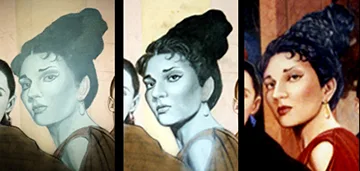
Represented from left to right were Shirley MacLaine, composer Niccolò Piccinni, Enrico Caruso, Martha Graham, Maria Callas, Martin Luther King, Mozart, Abraham Lincoln, Eugene O'Neill, a young Frank Sinatra, and Bruce Felder. Bruce, a patron and funder of the coffee house, was a Cleveland developer with a wicked sense of humor. He asked to be portrayed as a 'robber baron' (most of them had homes in Cleveland's millionaires row). He was followed by Ella Fitzgerald, Albert Einstein, Leonardo da Vinci, Nat King Cole, Vivien Leigh, Anna Pavlova, Rudolf Nureyev, and then Cleveland City Council president Mr. Jay Westbrook. Cleveland mayor Mr. Michael White also made the list. He was portrayed talking to pope John 23rd.
It should be noted that the photographs shown in this page are not the best; they are only intended for descriptive and identification purpose. John never photographed the mural sections in his small studio and photography inside the narrow and dimly illuminated coffee shop -and also filled with all manner of glass reflections, was an almost impossible task at best. Most of the panoramic images of the mural you see here were, with great care, time and thoroughness, stitched together in Adobe PhotoShop from different uneven sources. But at least viewers will get an idea of the ambitious scope of the project and the artistry that went into its creation.
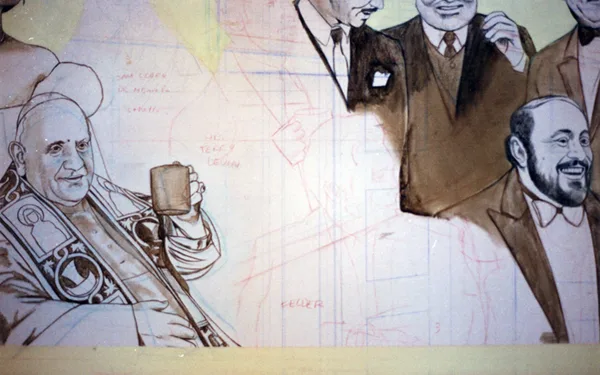
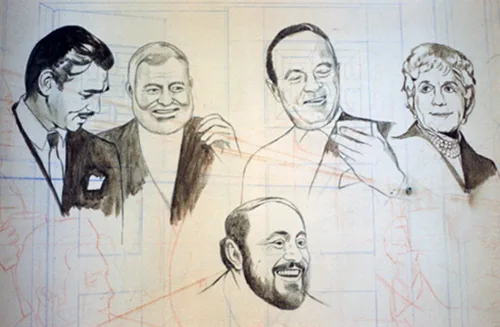
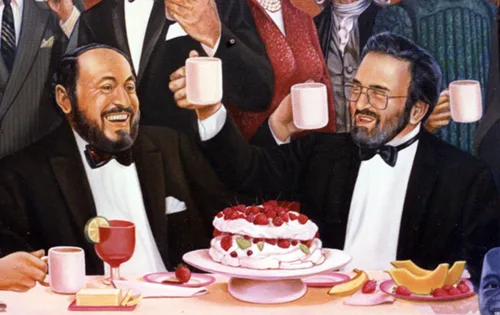
Completing the list on the main table scene are Vivien Leigh, Anna Pavlova, patrons Dr. Mark Levin and his wife Terry, Clark Gable, Earnest Hemingway, Bob Hope, Jack Benny (in drag), Voltaire, Nicolò Machiavelli, Aaron Copland, Beethoven, Count Basie, Paul Robeson, developer and patron Mike Miller, Luciano Pavarotti, Chuck Diamond, Elizabeth Taylor, Alfalfa, Gandhi, Buckwheat, Spanky, Joe Cobb (from Our Gang), Groucho Marx, Isaac Isimov, Bing Crosby, Rudolph Valentino, another patron as Chauser, and Dexter -Karyl's black Lab (long story).
In addition to their likenesses, individual traits had to be researched for details such as: -who was left handed, what did Gandhi eat, what was Hemingway's favorite drink, what kind of coffee pope John 23rd drank (it was Puerto Rican coffee), did Elizabeth Taylor really have violet eyes, what tie would look good on mayor Michael White, or what was Cleveland's most popular newspaper in the 1920's. Even selecting what food to serve was a challenge. Almost every detail had some significance.
The arrangement of the figures in the composition was dictated primarily on the availability of an usable photographic reference. More often than not the only choice was one single image because it could be maneuvered into a desired pose or because it had been lighted in a way fitting the rest of the composition. Models were then used to pose for the body of a character and living patrons were photographed in specific poses as interactive fillers in the montage.
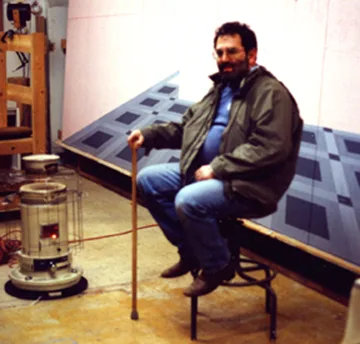
Under such limitations many personalities did not make it into the final composition; a few were later "edited" (eliminated, reversed, or altered) in the course of the project to suit the interactive flow of the characters. When questioned about his reasons for including or excluding a personality, John -with a puzzled expression, replied with one of his 'Johnisms': -"Well, we sent out invitations; those who made it made it."
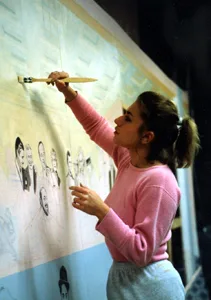
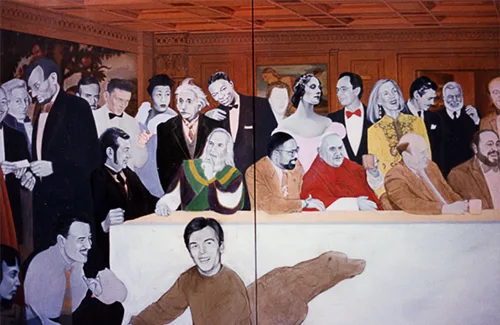
The color palette for the Thinkers Coffee House Mural was very limited, six colors at most. John decided instead to concentrate on tonal values. The coffee shop had large glass windows facing the street which provided natural light. But the windows were facing south and the mural wall was facing East. Very little sunlight reached the painting. These photographs are show at a higher exposure than the light at the space. The coffee shop's artificial lighting was adequate but not too bright.
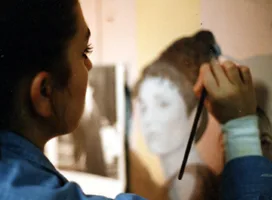
John's approach to compensate for the lack of good lighting was to switch to a style that was less painterly and more lineal (or more early renaissance than high renaissance). A lineal approach made the figures stand out more clearly because of the sharper outline. But his backgrounds looked very atmospheric due to his application of multiple layers of semitransparent paint to achieve great tonality of value.
Not everything in the mural was dictated by narrative or art. Notice the plain-looking coffee mugs. This was intentional. Always the businessman, Chuck Diamond figured that he could raise additional funding to further decorate the coffee shop by selling advertising and having it painted on the mugs -in an artistic way. After a good laugh, John though this was a brilliant idea as long as he got to paint the advertising on the mugs -and get a cut of the profits! People tend to forget that John has never been an artist who does business; he is a businessman that does art.
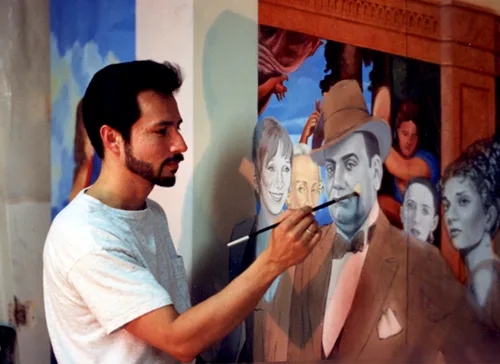
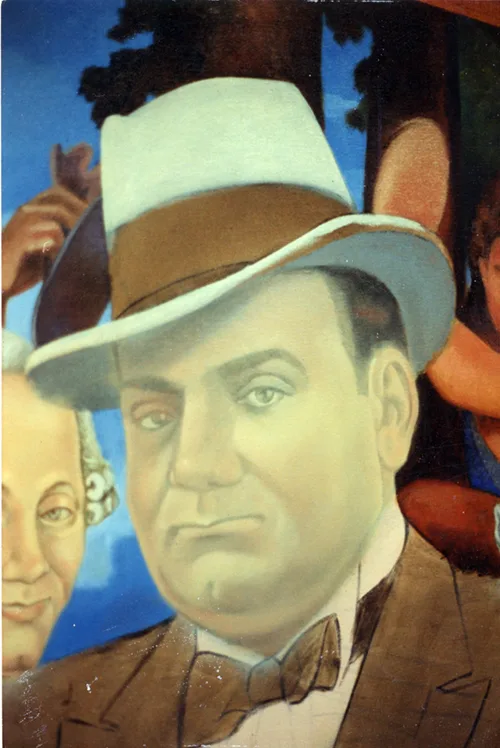
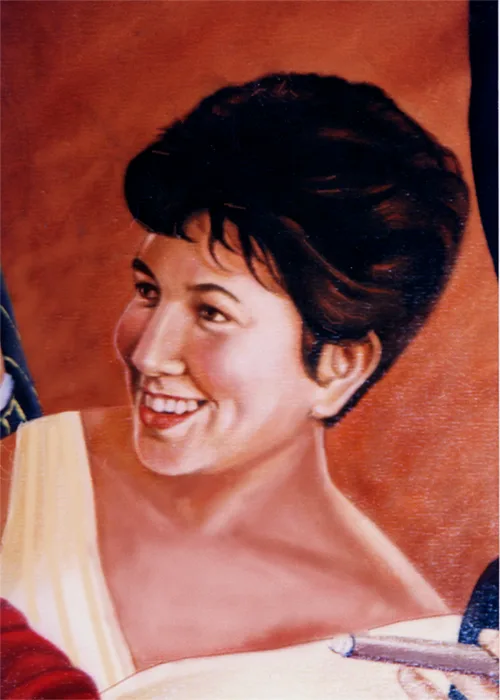
The mural was painted with artist's oils over canvas stretched wooden panels. After a subject was drawn in pencil, it was "inked" using fluid paint. Then the subject was painted in gray tone. If this looked acceptable and no further changes were needed, then color was applied in successive layers. By applying thin layers of semi-transparent paint you never worry about losing the likeness already achieved in the under-paint. This is a relaxing way of painting but it takes a long time to do. But painting into the early hours of the morning let the exhausted and coffee-charged painters into humorous arguments, which in turn resulted in some prank ending up in the mural. For example, Beethoven's hair has been moussed with heavy gel to resemble a modern day rock star. This was after John had completed a more traditional portrait of Beethoven. And, after a month of back-and-forth discussion (nagging), Karyl got her way and her dog 'Dexter' ended up in the painting.
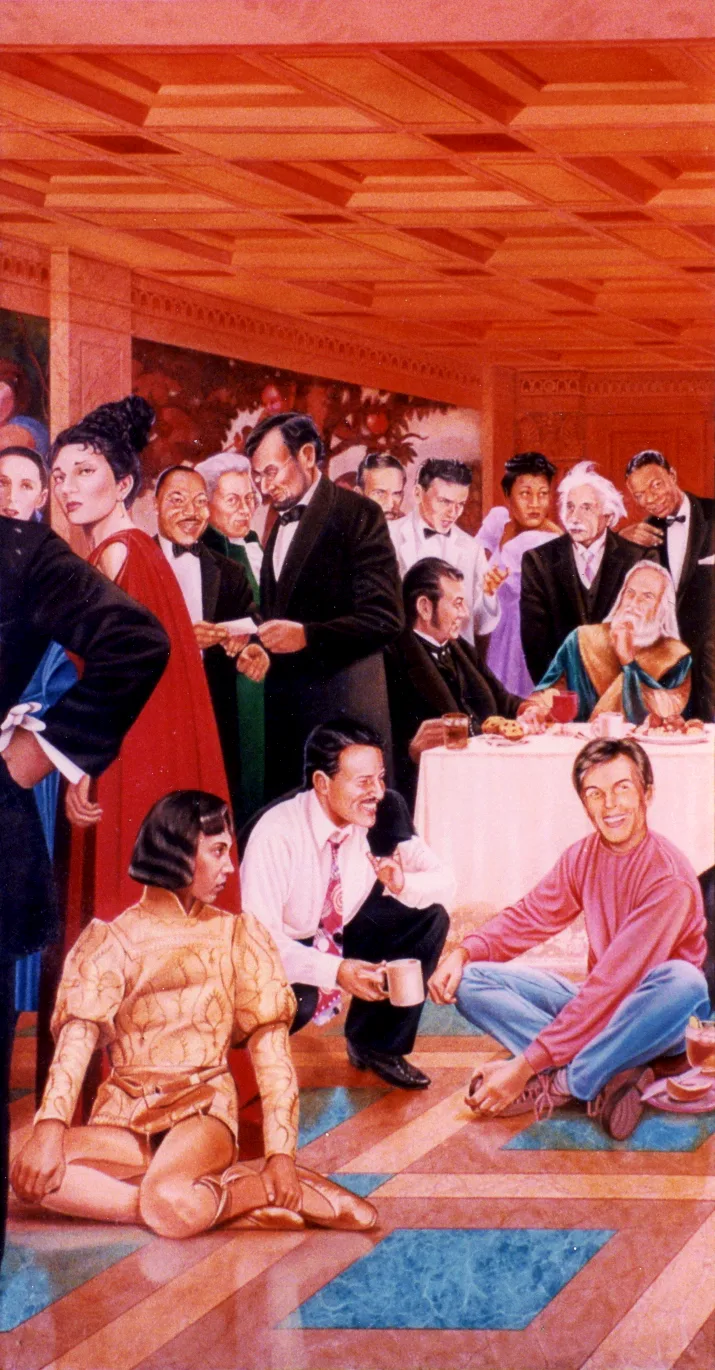
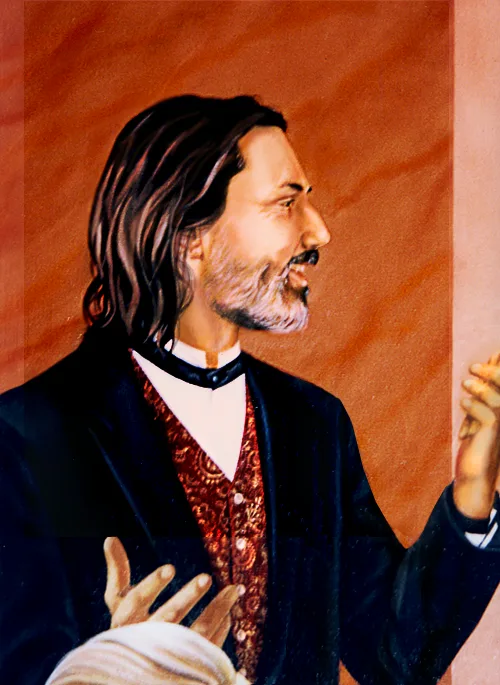
Also, Groucho Marx is giving direction to Joe Cobb in what appears to be a Shakespeare play (Joe was a popular character in 'Our Gang' before the series of shorts was renamed 'The Little Rascals'). Notice that Groucho is holding a copy of the play. The title page reads: "Friends, Romans, and Coffee drinkers: An adaptation of William Shakespeare's Julius Caesar" -by Alfalfa. Some more trivia: Spanky is holding up a copy of the 'Cleveland Examiner' with a headline that reads 'Celebrity Bash at Thinkers'. This actually was the real name of the mural though it never caught on. At the center of the picture you will notice the only personality in the entire mural not facing the viewer. But his trademark thick glasses, long bushy sideburns, and his penchant for square pattern jackets give his identity away. He is none other than the great thinker and author Isaac Asimov.
In addition to the main group tableau around the long table, the theme of the mural extended further into the coffee house. It shows "guest" as they arrived to the bash. Included were George Burns and Paul Newman take center stage. In the background is another patron and his charming wife gawking at the "the King" -Yul Brynner. Tom Hanks, who was an intern at Cleveland's Great Lakes Theatre, is also portrayed. Incidentally, upon learning of his inclusion among the "Thinkers celebrities", Tom Hanks sent a comment to Carlos Baerga -a Cleveland Indians baseball All-Star also prominent in the mural. The note read: -"It's an honor to be in the same painting with the pope and Carlos Baerga." It's common knowledge that Mr. Hanks is a baseball nut that spent his free time in Cleveland at the stadium rooting for the Cleveland Indians during their sad years.
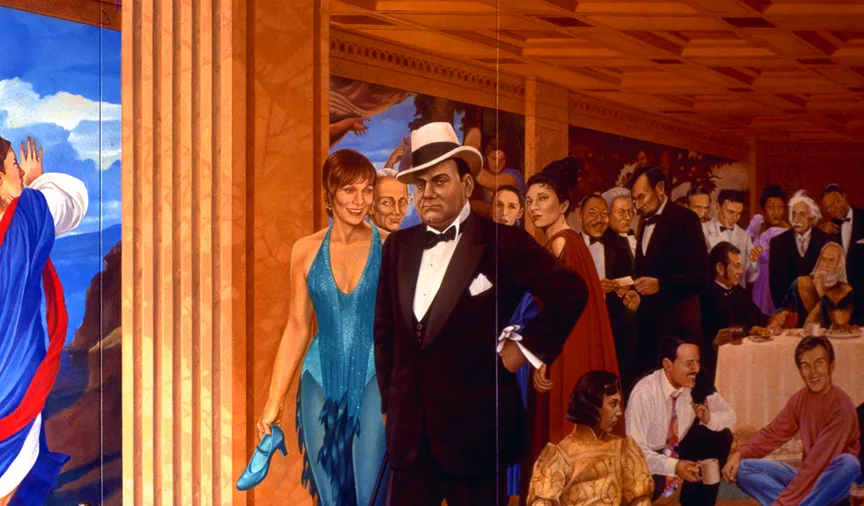
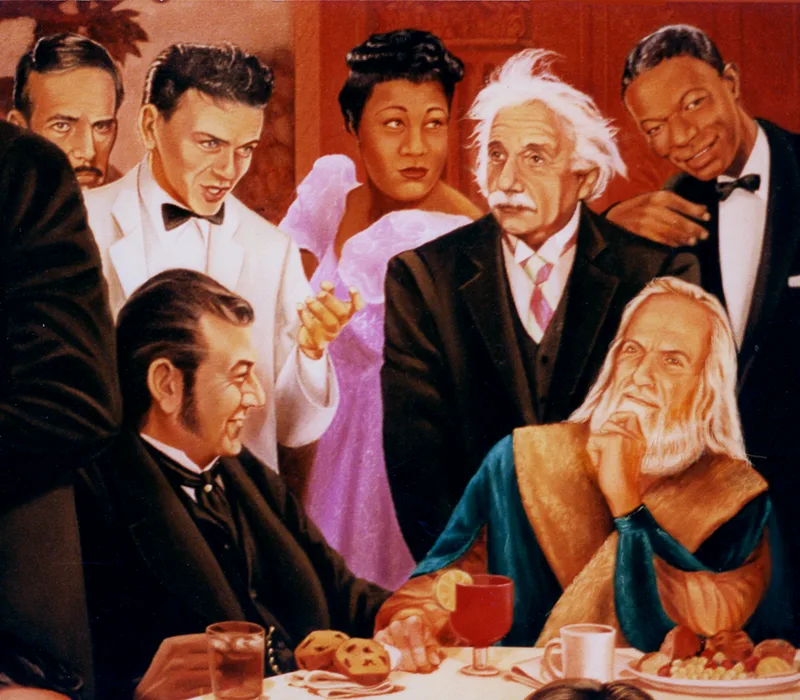
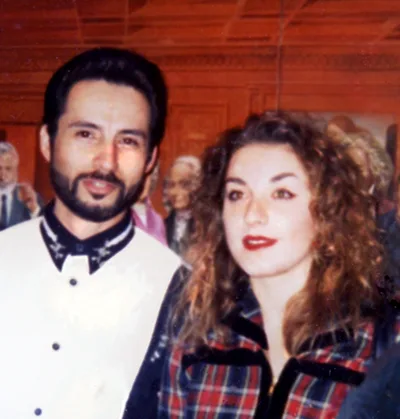
John's longtime friend and founder of the Cleveland Public Theatre (see 'The Street Sense Mural' on the Murals page), Mr. James Levin, is portrayed in the background behind Burns and Newman. He is admiring the lovely Karyl Kniepper as she walks down some steps. Jim and Karyl posed for the picture but John painted Jim in an Armani suit with a velvet and gold vest, the complete opposite of Mr. Levin's customary attire. John's experience in the theatre has been a major influence in is his painting and the Thinkers Coffee House Mural is John's foremost expression as a master of the "theatrical painting". The skillfully crafted 'mise en scène' composition is an art that John had already perfected in his theatrical work.
Cleveland Indian's baseball star Carlos Baerga is also feature signing a baseball for Paul Newman. Dr. and Mrs. Liu are at Carlos' right. John's longtime friend and founder of the Cleveland Public Theatre (see 'The Street Sense Mural' on the Murals page), Mr. James Levin, is portrayed in the background behind Burns and Newman. He is admiring the lovely Karyl Kniepper as she walks down some steps. Jim and Karyl posed for the picture but John painted Jim in an Armani suit with a velvet and gold vest, the complete opposite of Mr. Levin's customary attire. John's experience in the theatre has been a major influence in is his painting and the Thinkers Coffee House Mural is John's foremost expression as a master of the "theatrical painting". The skillfully crafted 'mise en scene' composition is an art that John had already perfected in his theatrical work. Additional guests for good measure were a young Fred Astaire and French actor Jean Reno.
Since its unveiling in 1995, the Thinkers Coffee House Mural was a smash with the public. People came as far as Cincinnati (a city at the opposite end of the state) to see the mural. Several art classes had gatherings at the coffee house to enjoy and study the work. Being located in the theatre district meant that touring companies coming to Cleveland would invariably stop in for coffee and discover the painting. "John & Karyl" became the darling of many art and social gatherings with more work to follow. John also accepted several speaking engagements in area schools and colleges, from Kent State to the Cleveland Institute of Art -the same institution that had denied him entry in their Painting Program in 1979.
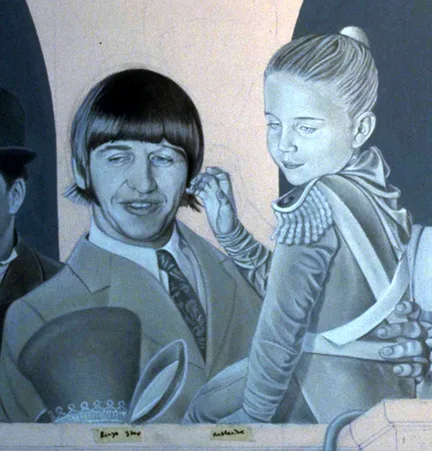
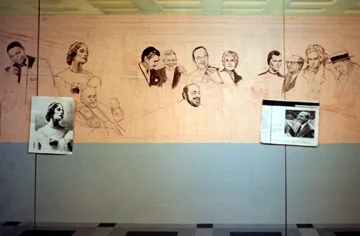
Encouraged by the success of the piece, Chuck Diamond contracted John to work on another extension to the mural. A new gallery of celebrities would be added on top of the mural as if looking over a balcony. This time around there was no shortages of people wanting to be in it. John went as far as to paint the new mural addition in grey tones in a composition that he considered far better than the first one. The survivor photographs of the work-in-progress give ample evidence of this claim. However, the work was never completed and the panels were left as they appear on this photographic record. Note: see other panels for the addition in the above video.
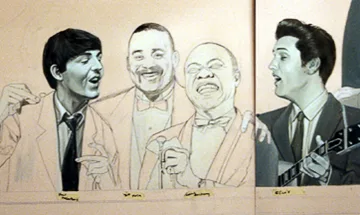
Several factors contributed to the cancellation of the project. First was the Cleveland economy. While Playhouse Square was undergoing a revival, its downtown area had lost residents and business during the 1980's recession. This in turn meant that the coffeehouse was not generating the projected revenue. Also, Mr. Chuck Diamond -the heart of the project, who had suffered from polio all his life, realized that the pressures of business had taken a toll on his health. He could no longer effectively manage the enterprise. New owners took over but they did not honor the former agreement concerning the mural. Finally, after negotiations went nowhere, John exercised a contractual clause of owning the artwork until every cent was paid. So after two years of being on display, John removed the mural panels from the coffee shop and put them in storage. The Thinkers coffee house went out of business the following month.
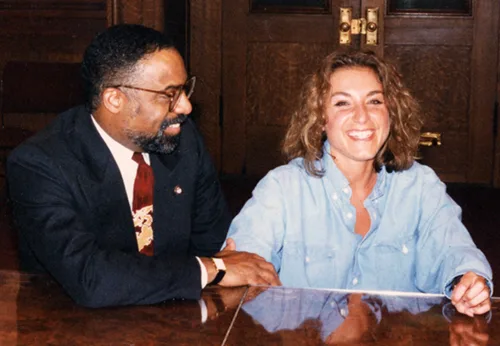
Charles N. Diamond. A friend and a patron. July 3, 1941 - July 24, 2017
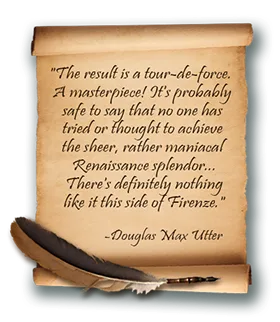
We can only imagine what the entire Thinkers Mural would have looked like if business had not ruled over art. The people of the city of Cleveland lost more than just a painting; they lost a legacy. Perhaps the most fitting reminder about John's artistic genius and the Thinkers Coffee shop Mural was the one that appeared on the Cleveland Free Times penned by art critic Douglas Max Utter: -"The result is a tour-de-force. A masterpiece! It's probably safe to say that no one has tried or thought to achieve the sheer, rather maniacal Renaissance splendor... There's definitely nothing like it this side of Firenze."